
How to choose LED grow lights: coverage, controls and running costs
A practical guide to comparing LED fixtures, reading a PPFD map and estimating electricity use before you buy.
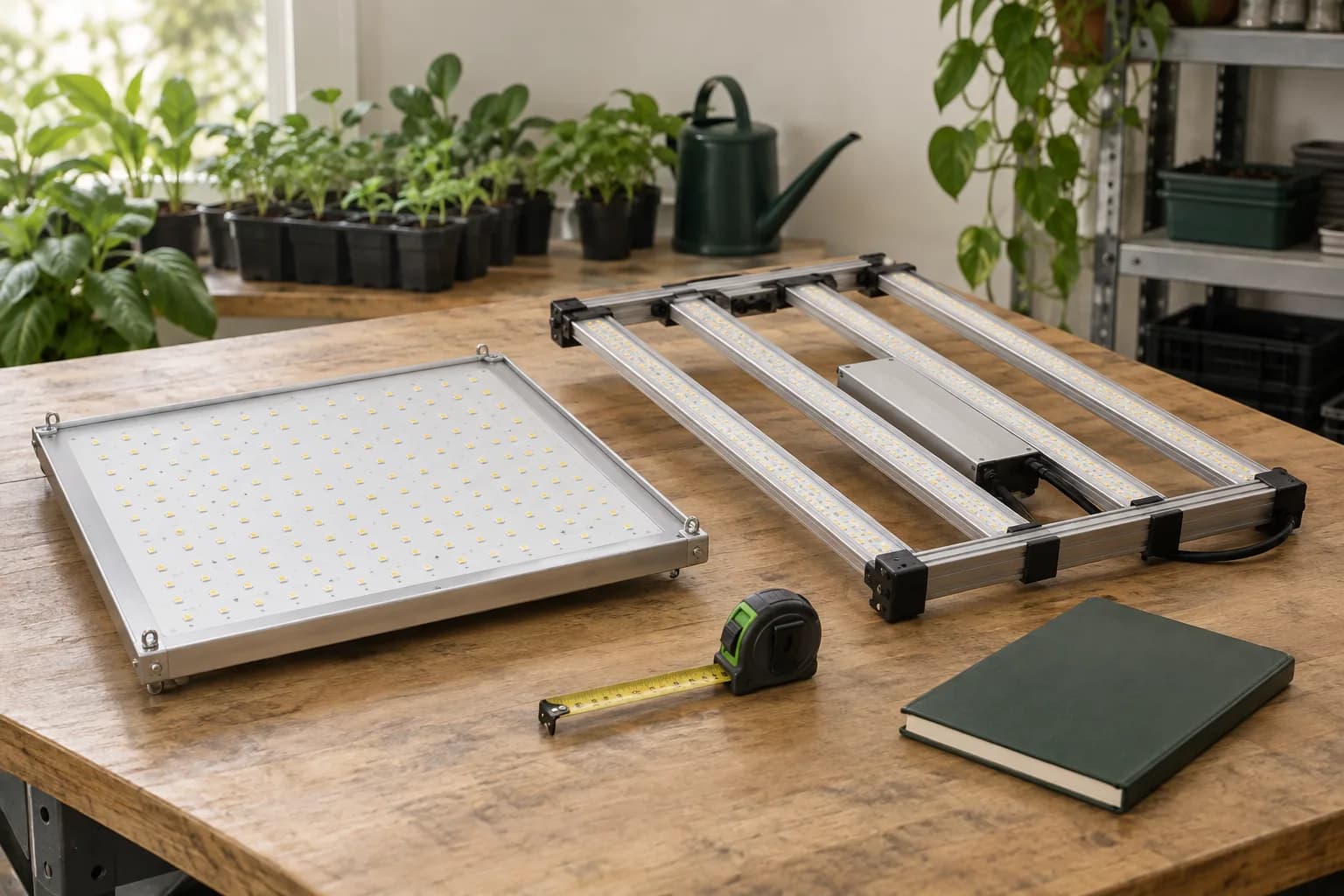
Choosing a grow light is easier when you start with your space and the plants you want to grow. A large wattage number alone cannot tell you whether a fixture fits, lights the whole area evenly or works with your existing equipment. For an indoor herb shelf or a grow tent, these are the questions that make a shortlist useful.
Measure the space above the plants
Write down the usable width, depth and height of your growing area. Then account for the pots, plant height, hanging hardware and the clearance required by the light's instructions. A fixture that fits the floor dimensions may still leave too little room above the plants. For a shelf measuring 80 × 80 cm, sketch the position of the light, its power supply and the cable route before ordering. This catches practical problems that are easy to miss in a product photograph.
Read the light map, including the corners
PPFD describes the photosynthetically active light reaching an area, commonly expressed in µmol/m²/s. Apogee explains this measurement in its sensor documentation. A manufacturer's PPFD map can help compare the centre and edges of the stated footprint. Check the height and test conditions printed beside the map before comparing two fixtures. A bright centre with much weaker corners raises a different question from an even spread: where will your pots actually stand?
Separate electrical watts from coverage
Rated electrical consumption helps you estimate power use; it does not replace a coverage map. Put the fixture dimensions, stated coverage, test height and rated consumption in separate columns on your shortlist. If one listing gives only a model name such as '600', ask for its actual electrical specification. Avoid treating the name as a measured wattage. Keep comparisons tied to the same growing area rather than choosing whichever product has the biggest number.
Check dimming and the complete installation
Look for the controls you will actually use: an onboard dimmer, a compatible controller or a documented timer connection. Confirm which cables and hangers are included. Manufacturer guidance on hanging height and dimming is model-specific; Mars Hydro's guide illustrates why these settings need to be considered together. Keep the relevant installation instructions with the product. If a connector or controller is unspecified, ask about that exact version instead of assuming compatibility from a similar-looking socket.
Work out a realistic electricity example
For a hypothetical fixture drawing 150 W and running 16 hours a day, the calculation is 0.15 kW × 16 hours × 30 days = 72 kWh over 30 days. Multiply that figure by your own electricity price to estimate the lighting cost. At an illustrative €0.30/kWh, the result is €21.60; this is an example, not a current tariff or a recommended lighting schedule. Fans and other equipment need separate calculations. A dimmed fixture may draw less power, so use measured consumption or the manufacturer's figures when available.
Make a shortlist you can act on
Choose two or three fixtures and collect the missing details before comparing the purchase price. Include any separate hanging kit, controller or cable in the total. Record the manufacturer's warranty and the seller's support information beside each option. A lower initial price can lose its appeal if the package is incomplete or an important specification remains unclear. Bring your measurements and exact model references to a consultation so the discussion starts with your actual setup.